
La mayoría de los compradores adivinan.
The vast majority of suppliers will not bother answering.
That’s one of the biggest unseen risks in the procurement of envases de vidrio, as wall thickness variation is not usually listed on a quotation sheet, but it directly influences breakage rates, the performance of the glass-filling line, thermal shock resistance, stability of the glass-pallets system, and long-term customer complaints.
This is something that I learned years ago looking at a rejected batch of 500ml botellas de leche de vidrio. The supplier claimed that the bottles conformed with dimensional requirements. The buyer was convinced that the bottles were failing during pasteurization. Both were grammatically accurate.
It was not the size of the bottle.
It was the distribution of thickness.
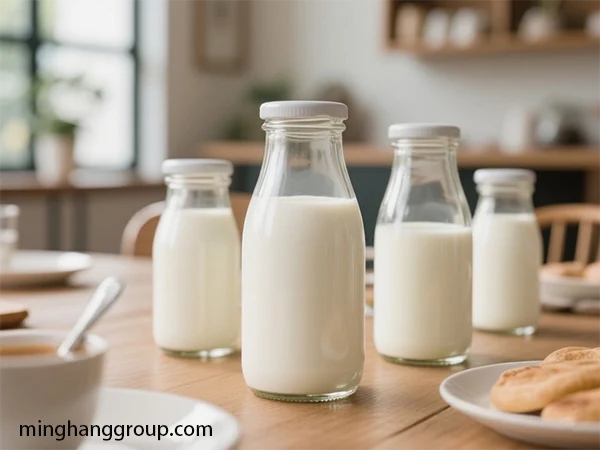
The Importance of Glass Milk Bottle Wall Thickness Tolerance
A glass milk bottle is NOT a solid block of material.
It is a pressure container.
Each millimetre of glass will affect the stress distribution throughout the container during filling, capping, refrigeration, transportation and consumer use.
If the thickness is too uneven, the stress doesn’t distribute evenly.
Instead, it concentrates.
That concentration makes weak points.
It is possible for a bottle to pass inspection in the glass bottle factory but to break during shipping or in the pasteurizer weeks later.
That’s why more and more professional dairy brands are demanding documented glass milk bottle wall thickness tolerance reports prior to enabling mass production.
How Thick Can The Wall Be In The Glass Milk Bottle Before It Fails?
The short answer:
Most commercial buyers are looking for a wall thickness range of ±0.3 mm to ±0.5 mm depending on the bottle design, bottle filling conditions and quality specifications.
Many procurement specifications call for the following for premium dairy packaging:
| Tipo de botella | Typical Wall Thickness | Recommended Tolerance |
| 250ml Milk Bottle | 2.5–3.0 mm | ±0.3 mm |
| 500ml Milk Bottle | 3.0–4.0 mm | ±0.3–0.5 mm |
| 1000ml Milk Bottle | 3.5–4.5 mm | ±0.5 mm |
| Returnable Milk Bottle | 4.0–5.5 mm | ±0.3 mm |
But here is the uncomfortable reality.
Many factories only measure average thickness.
The average number means very little if one side measures 2.7 mm and the opposite side measures 3.8 mm.
The bottle may technically meet average specifications while still carrying a significant structural imbalance.
The Hidden Cost of Wall Thickness Variation
Three words.
Stress concentration zones.
A bottle with uneven thickness expands and contracts unevenly during temperature changes.
Consider a milk processing line:
- Bottle temperature: 18°C
- Filling temperature: 72°C
- Cooling tunnel: 4°C
The glass experiences multiple thermal transitions within a short period.
Areas with reduced thickness absorb heat faster.
Thicker regions expand more slowly.
The result?
Internal stress.
And stress accumulation is one of the leading causes of bottle failure.
According to research published by the National Institute of Standards and Technology (NIST) on glass material behavior, structural inconsistencies significantly influence fracture propagation under thermal and mechanical loading conditions.
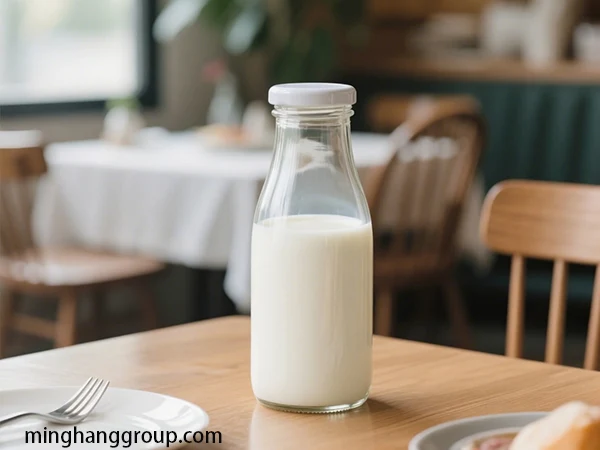
How Manufacturers Measure Glass Bottle Wall Thickness Uniformity
This is where supplier quality separates itself.
A serious manufacturer does not rely on visual inspection.
Instead, thickness is measured using multiple methods.
Ultrasonic Thickness Gauges
The most common industrial solution.
Advantages:
- Non-destructive
- Fast measurement
- Suitable for mass sampling
Laser Scanning Systems
Used by higher-end manufacturers.
Advantages:
- Full profile mapping
- Higher accuracy
- Automated data collection
Sectioned Sample Analysis
H3: Sectioned Sample Analysis
A destructive laboratory method.
Advantages:
- Extremely accurate
- Useful for mold validation
Disadvantages:
Not suitable for every batch
Why Thickness Uniformity Matters More Than Average Thickness
I often see buyers asking:
“What is the bottle wall thickness?”
Wrong question.
The better question is:
“How uniform is the wall thickness throughout the bottle?”
Consider these two examples.
| Bottle A | Bottle B |
| Average Thickness: 3.2 mm | Average Thickness: 3.2 mm |
| Variation: ±0.2 mm | Variation: ±0.9 mm |
| Uniform Stress Distribution | High Stress Concentration |
| Better Thermal Performance | Higher Failure Risk |
Both bottles report the same average thickness.
Only one performs reliably.
What Causes Excessive Thickness Variation?
Several manufacturing factors contribute.
Mold Wear
As molds age, glass distribution becomes less consistent.
Extended mold life saves factories money.
But it often increases dimensional variation.
Gob Weight Inconsistency
Aquí es donde los profesionales marcan la diferencia.
No negociando el precio. Controlando la inspección.
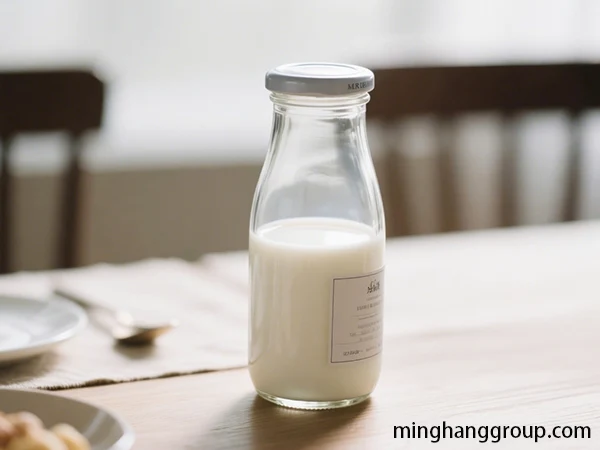
Blow-and-Blow Process Variability
Machine settings influence how glass spreads inside the mold.
Poor calibration results in uneven wall formation.
Temperature Instability
Glass viscosity changes with temperature.
Even minor furnace fluctuations can affect thickness distribution.
Bulk Glass Milk Bottle Thickness Standards Buyers Should Request
Professional importers increasingly require:
| QC Requirement | Recommended Standard |
| Thickness Variation | ±0.3–0.5 mm |
| Visual Inspection | 100% Automated |
| Sampling Plan | ANSI/ASQ Z1.4 |
| Annealing Verification | Required |
| Thickness Mapping Report | Required |
| Production Sample Approval | Required |
Many suppliers provide dimensional drawings.
Far fewer provide thickness distribution reports.
That distinction matters.
Why Returnable Milk Bottles Need Tighter Tolerances
Reusable bottles face additional stress.
Each cycle includes:
- Collection
- Washing
- Sterilization
- Refilling
- Transporte
After 10–20 reuse cycles, small structural inconsistencies become larger performance risks.
According to packaging research discussed by Reuters manufacturing coverage, sustainability initiatives continue increasing demand for reusable packaging systems, placing greater emphasis on durability testing and lifecycle performance.
For returnable systems, many dairy brands specify tighter thickness tolerances than single-use containers.
Glass Milk Bottle Quality Control Inspection Checklist
Before approving production, buyers should verify:
✔ Thickness uniformity report
✔ Annealing inspection report
✔ Mold maintenance records
✔ Thermal shock testing data
✔ Compression test results
✔ Impact resistance test results
✔ Production sample approval
✔ AQL inspection plan
Missing even one of these documents increases sourcing risk.
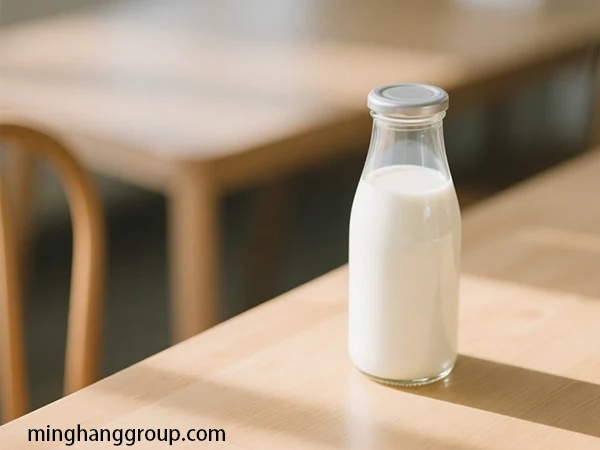
Comparison of Thickness Tolerance Risk Levels
| Thickness Variation | Nivel de riesgo | Typical Outcome |
| ±0.2 mm | Bajo | Stable performance |
| ±0.3 mm | Bajo | Suitable for most dairy applications |
| ±0.5 mm | Moderado | Acceptable with proper QC |
| ±0.8 mm | Alto | Increased thermal stress risk |
| ±1.0 mm+ | Crítico | Elevated breakage potential |
Preguntas frecuentes
What is the acceptable wall thickness tolerance for 500ml glass milk bottles?
For 500ml glass milk bottles the acceptable wall thickness tolerance is usually around ±0.3 mm to ±0.5 mm, but it really depends on the bottle design , the filling temperature, how it gets transported, and what the buyer plus manufacturer set as quality expectations.
In general, higher quality dairy packaging tries to stay closer to the tighter side of that interval, more like “precise control” rather than loose consistency.
How do manufacturers measure glass milk bottle wall thickness?
Most manufacturers measure glass bottle wall thickness using ultrasonic gauges, laser scanning systems, and sometimes destructive lab sectioning, where they cut a sample to look at thickness distribution. That way they can spot spots that could become a structural weak point later on.
The main idea is more about uniformity across the whole bottle body, not just chasing the average thickness.
Why does wall thickness variation matter?
Wall thickness variation matters because uneven glass distribution can create localized stress concentrations during filling, cooling, capping, and transport. So even if the overall dimensions look fine, the bottle can still break more easily, basically because the stress builds in specific areas.
Uniformity tends to improve durability, and the whole supply feels more reliable in real world handling.
What thickness variation should trigger supplier concern?
If the thickness variation goes beyond about ±0.5 mm, suppliers should usually treat that as a flag and investigate further. This is especially true for hot-fill, pasteurized, or returnable milk bottle use, since thermal plus mechanical loads are higher there and any thin zone can become a problem faster.
The acceptable threshold depends on application requirements.
Should buyers request thickness reports from suppliers?
Yes. Professional buyers should request thickness mapping reports because dimensional drawings alone cannot verify structural consistency, while thickness data provides insight into production quality and potential performance risks.
The Hard Truth About Glass Bottle Procurement
Many importers negotiate aggressively on price.
Few negotiate aggressively on thickness uniformity.
That is backwards.
A bottle can be the cheapest option on the quotation sheet and still become the most expensive component in the supply chain once breakage, downtime, replacement costs, and customer complaints are included.
Wall thickness is not just a technical specification.
It is a profitability metric.
CTA
Looking for a reliable glass milk bottle manufacturer?
Request our free sample pack, wall thickness mapping report, annealing inspection data, and bulk production QC checklist before placing your next order. Our factory provides custom glass milk bottles with strict tolerance control, fast lead times, and wholesale pricing for dairy brands, distributors, and importers worldwide.
Humanize 346 words



 ES
ES  EN
EN  FR
FR  DE
DE  RU
RU  IT
IT  PT
PT  AR
AR  TR
TR  KO
KO  JA
JA  ZH
ZH