
There is no such thing as a boring product page when it features a custom glass vase. It is a different story if they are to make 5,000 copies of this identical item.
Customization isn’t simply a matter of selecting a silhouette and providing a color reference to an importer, home décor brand or floral supplier or wholesaler. A factory has to translate a design into a workable mold, choose an appropriate glass composition, manage the forming process and make the same approved appearance during an entire production run.
That’s where projects can get costly. An elegant shape in a 3D model can be challenging to mold. A specific colour may look great in a sample, but quite different when applied to hundreds of finished vases.
The question is whether it is possible for a glass vase supplier to produce custom designs. It is whether the factory can produce it on a regular or repeated basis at a viable commercial price.
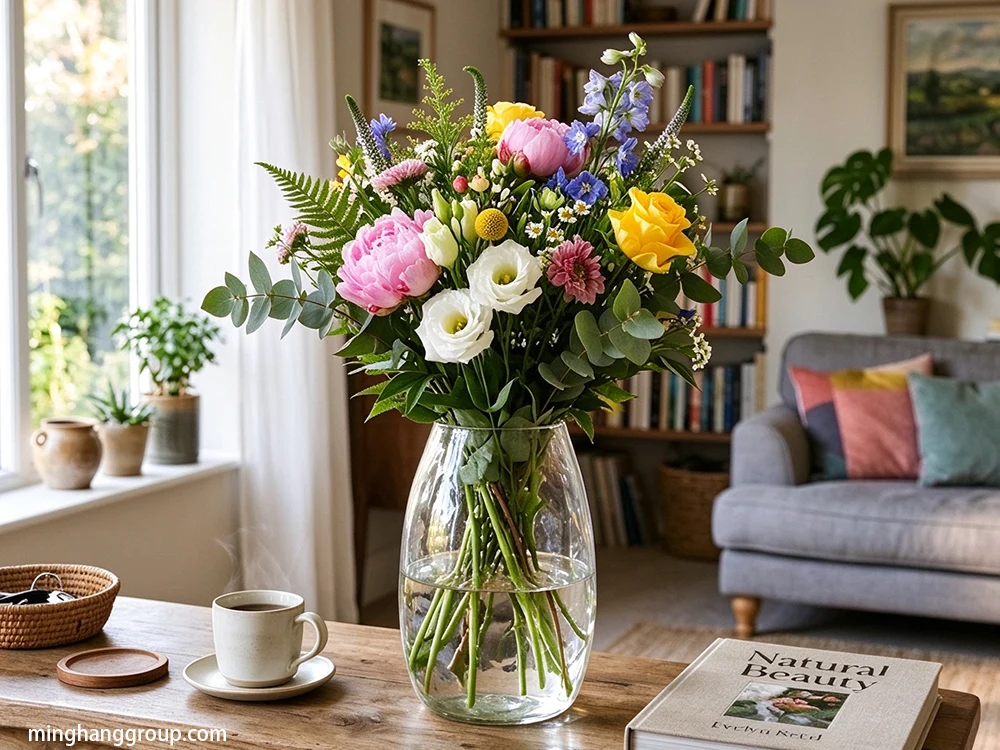
1. How Does a Glass Vase Supplier Handle Custom Shapes and Colors?
The majority of custom glass vase projects start with a reference photo, drawing, glass sample or 3D model. The design is examined by the technical team of the factory before it is manufactured.
There are three aspects that should be considered early:
- The dimensions are: height, maximum diameter, opening diameter, base width and wall thickness.
- Geometry: Curves, shoulders, transitions at neck and other decorative grooves.
- Manufacturing feasibility: Mold release, Glass distribution, Glass forming stability and cooling behavior.
For instance, a vase with a rounded shape and a broad base can be more challenging to adjust the mold and form than a straight cylindrical one. Additionally, deep grooves and sharp transitions can also be more challenging to achieve even glass distribution.
1.1 How to Design Glass Vase Mold?
The mold is a critical first step engineering decision for many custom glass vase shapes. Under different forming processes and product designs, manufacturers can use multi-section metal molds to form the requested shape.
A typical development process for a practical will generally involve the following:
- Checking the buyer’s references or drawing.
- Validation of dimensions and design tolerances.
- Assessment of moldability and feasibility of mold forming.
- Making or altering the mold.
- Making trial samples.
- Inspecting the appearance, size and stability.
- Voting on the last specimen prior to the start of mass production.
Don’t approve a mold without a real mold. A rendering will not show all the problems that may be encountered while forming glass.
For the buyer, it is important to ask for a technical drawing, dimensions, a sample approval record and the actual owner of the custom mold.
2. What Are The Colors That Can Be Used For Custom Glass Vase?
No, coloring glass isn’t just a question of sparing paint over a completed vase. In many instances, the color is provided by the use of a specific colorant added to the batch (or melt) used to make the glass.
According to the Glass Packaging Institute’s explanation of glass coloring, different metal oxides and other colorants can produce different colors. Green is related to chromium compounds; blue is related to cobalt oxide; and red is related to selenium. These final colours are dependent on the composition of the glass and the processing conditions.
To wholesale buyers, this difference is significant.
Color on the glass and color applied to the surface are two separate products. They may appear alike in a picture, but they’re produced differently, finished, last, and cost differently.
2.1 Common Glass Vase Coloring Methods
| Coloring method | Aparência | Commercial considerations |
| Colored glass material | Color extends through the glass | Suitable for consistent, integral color; requires control of glass composition |
| Spray coating | Color applied to the exterior | Broad color options; coating durability needs testing |
| Transparent color finish | Tinted appearance with visible transparency | Useful for decorative and premium designs |
| Acabamento fosco | Soft, translucent surface | Can create a muted, refined appearance |
| Decoração de superfície | Printed or patterned details | Suitable for logos, motifs, and brand-specific designs |
For instance, if the buyer wants a glass with a blue cobalt finish, the buyer should clarify if it needs to be incorporated into the glass or if it is a surface finish. These strategies should never be confused with one another.
2.2 What Are The Ways That Buyers Can Indicate Custom Glass Vase Colors?
A colour name is not a production specification.
The term “dark green” or “champagne” is too ambiguous. Rather, the buyer can submit a physical sample, a Pantone reference (where applicable) or a physical or specific digital color target.
Even as far back as then, a digital colour code is just a beginning. The final color may change due to glass transparency, thickness, light and background.
To ensure a more certain approval process, buyers should:
- Use a physical swatch of the color used, if possible.
- Verify if the color is transparent, translucent or opaque.
- Describe the finish, glossy, matte or frosted.
- Inspect samples under the same lighting conditions.
- Sign or retain reference sample prior to mass production.
3. Custom Glass Vase Shapes and Colors: Buyers' Comparison
Not all customizing techniques are created equal. The needs of a buyer placing 300 vases for a boutique collection are different from those of a distributor who wants to order 10,000 vases to sell through a retail program.
The following comparison shows the typical commercial compromises. The actual costs and minimum order quantities will vary according to factory, design, toolings and production process.
| Customization option | Tooling investment | Flexibilidade de design | Best suited for |
| Existing mold with standard glass color | Usually low | Limitado | Small wholesale orders |
| Existing mold with custom surface coating | Usually low to moderate | Moderate to high | Brand color matching |
| New mold with standard glass color | Higher upfront cost | Alto | Distinctive vase silhouettes |
| New mold with custom colored glass | Higher upfront cost | Very high | Exclusive product collections |
| Existing shape with printing or decoration | Usually low to moderate | High for surface graphics | Logo and pattern customization |
But the key calculation is not that of the unit price.
Suppose you sell an order for 5,000 vases. But if the tooling cost is distributed over the first 5,000 vases and a new mold is $2,500, it’s an extra $0.50 per vase. When the tooling cost is $20,000 and the number of vases produced is 20,000, the cost per vase is $0.125.
All figures are based on estimates, not on quotations. They explain why order quantities and repeat buying plans should be discussed prior to approval of a custom mold.
4. How Can A Supplier Ensure Consistency In Bulk Production?
A good sample doesn’t make a good shipment.
In mass production, the dimensions, glass appearance, forming defects, annealing and packaging must be monitored in the factory. Color consistency should be given special consideration for customized products.
The following points should be included in a practical inspection plan:
| Inspection stage | What the factory checks | Why it matters |
| Incoming materials | Glass batch and colorant specifications | Reduces material variation |
| Mold preparation | Mold condition and dimensions | Helps maintain shape consistency |
| Forming | Surface appearance and glass distribution | Identifies forming defects |
| Annealing | Cooling process and residual stress control | Helps reduce stress-related breakage |
| Finished product | Height, diameter, opening, base, and color | Confirms conformity to the approved sample |
| Embalagem | Dividers, protective materials, and carton strength | Reduces transport damage |
Dimensional tolerances must be agreed upon prior to production, not during. British Glass offer technical advice in tolerances for glass containers, including a document that was updated in July 2024. While container guidance does not necessarily have to be assumed as a standard specification for decorative containers, it does remind the reader of the importance of specifying measurable tolerances with the manufacturer.
4.1 What to Include in A Quality Agreement?
Whenever a wholesale order is to be made, the following specification should be made on a written order:
- Approved product drawing & dimensions.
- Acceptable dimensional variation.
- Colour reference and visual acceptance conditions.
- Surface defect criteria.
- Base stability/vertical alignment requirements.
- The way the packages were packed and type of carton.
- Arrangements for inspection and sampling.
When there is an existing inspection standard agreed upon by both parties, a sample size and its associated acceptance number, then AQL sampling may be used. It should not be relied upon to replace the definition of what constitutes a defect.
5. What Questions Need to Be Asked to the Glass Vase Supplier?
The process should be explained by the professional supplier, and not just that any design is possible.
Consider the following questions before ordering in bulk:
Are you able to make from a drawing or can you make only a sample?
This indicates if the supplier will have the ability to design development or if the supplier will be mainly able to reproduce existing products.
Who will be responsible for the mold and who will have the rights to it?
In writing settle mould charges, who’s responsible for maintenance, storage and ownership.
Are you able to match a physical colour reference?
Inquire about the factory’s control techniques for color during manufacturing and if the factory keeps an approved sample.
Will there be a sample of this product for me to get before it goes into production?
A physical sample must be satisfactorily examined prior to issue of the complete order.
What strategies do you have to prevent breakage in transit?
Ask for information with regard to dividers, inner packaging, carton strength, palletization and all relevant transport tests.
Are you able to repeat order?
A supplier should be able to describe how it logs the mold data, material data and color references for future batches to compare to the approved batch.
6. Significance of the Right Glass Vase Supplier in the Long-Term Supply
A low quote may not include mold or decoration, packing or quality inspection. This is also true of an attractive sample that is difficult to duplicate.
In B2B transactions, the cheapest glass vase supplier isn’t always the best choice. This is the supplier who can take a design and provide a viable production specification, understand the cost of customization and ensure the design is repeated with the same appearance on repeat orders.
In the case of a decorative vase, consumers should also recognize the difference between a normal decorative product and one that will be used for food. If a product is sold for food contact, the relevant market requirements will need to be addressed. The European Commission gives an explanation of the framework according to Regulation (EC) No 1935/2004 and Good Manufacturing Practice Regulation (EC) No 2023/2006. Rather than making these the general rules for any decorative vase, the following points may serve as a guide to good judgment for your vase collection.
7. Perguntas Frequentes
Is it possible to make a glass vase with a picture from a glass vase supplier?
Yes. It is possible that a glass vase supplier can use a reference picture as a starting point for custom development, but a photograph however, may not contain enough technical information. The buyer should give the supplier the dimensions, other viewing angles, a physical sample or a 3D drawing, through this the factory evaluates the mold design and the feasibility of mold production.
Are there any manufacturers that can replicate a given Pantone colour for glass vases?
The Pantone reference is a tool a manufacturer can use to match a colour, but isn’t a guarantee that the colour will match on the skin. The final appearance will depend on the level of transparency of the glass; its thickness; the light or colouring technique used; and this should be agreed by the buyer in a sample which is viewed in a physical sample under agreed conditions.
Should the custom glass vase be remolded?
Not always. If a mould already exists, and it has a similar shape and size to what is needed, it may be possible to use the same mould for a different colour or surface finish. The buyer will usually need a new mold if he/she desires a material with a substantially different silhouette, size or structural detail.
The minimum order quantity for wholesale custom glass vases
There is no fixed number of pieces for custom vasos de vidro. It depends on whether it is a duplication of an existing mold, needs special tooling, special glass colours or any other additional decoration required. They should request individual quotes for sample development, tooling and bulk production.
What are some ways in which buyers can minimize the occurrence of different colors in batches?
The buyer should agree and retain a sample which must be in hard copy, the colouring method should be stated and production checks made against the set standard. When ordering repeat runs, it is also important to confirm the factory’s colour specification and colour tolerance.
8. Get A Custom Glass Vase Quote
Looking to create a new collection of vases? Before contacting a supplier, it is important that you have reference images/drawings, order size, colors, and your desired size.
A good glass vase manufacturing company should have the ability to take in the design and explain to you what is required for the mould, their ideas about the colour options that they believe will be suitable and be able to give you a quote that includes the cost of the mould, sampling, manufacturing and packaging.
Please talk to us about custom glass vase shapes, colors, samples and wholesale production requirements.
 PT
 EN
 FR
 DE
 RU
 IT
 ES
 AR
 TR
 KO
 JA
 ZH